

- This event has passed.
8:00AM-5:00PM: Radio Engineering
July 26, 2023 @ 8:00 am - 5:00 pm
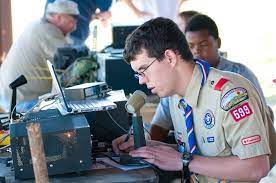
Exhibit #1: Listen to an AM signal with a hardwater-built radio
AM broadcasting is radio broadcasting using amplitude (AM) transmissions. It was the first method developed for making audio radio transmissions, and is still used worldwide primarily for medium waves (also known as “AM band”) transmissions, but also on the long wave and shortwave radio bands. Compared to FM or digital transmissions, AM transmissions are less expensive to transmit and can be sent over long distances, however they are much more susceptible to interference, and often have lower audio fidelity. Thus, AM broadcasters tend to specialize in spoken-word formats, such as talk radio, all news and sports, with music formats primarily for FM and digital stations.
We will build an AM Radio receiver by creating a custom circuit consisting of capacitors, diodes transistors, resistors, an inductor, antenna, and headphones.
Exhibit #2: Listen to a “HAM” radio broadcast
Amateur Radio (ham radio) is a popular hobby and service that brings people, electronics and communication together. People use ham radio to talk across town, around the world, or even into spaces, all without the Internet or cell phones. It’s fun, social, educational, and can be a lifeline during times of need.
Demonstrate tuning a shortwave reciever
Exhibit #3: Listen to an FM Signal with a software built radio
Every time that we listen to the music on the car radio above between 80-110 MHz, our radio receiver performed a demodulation of a Frequency Modulated (FM) signal. Frequency modulation changes the frequency of a transmitted signal over time to reflect the data being transmitted. In the diagram we show an example of x(t) that we want to transmit at a high frequency. To do that, we use FM to change the frequency of the carrier wave to increase/decrease with our radio signals x(t). Notice how when the x(t) wave is above the green increases and how when it’s below, it decreases.
We will build a FM radio receiver in the GNU Radio Companion to listen to our local FM radio stations. To do this, plug your RTL-SDR USB peripheral into your computer’s USB port. This USB stick reads the information from the radio antenna, amplifies and filters the radio waves, and then passes the data to the computer for processing.
Exhibit #4: Focus Photons with a Parabolic Dish
As their name suggests, satellite dishes catch electromagnetic signals from satellites that transmit your favorite movies, sports matches, or whatever other programmed you like to watch. You can think of these signals as arriving from space in the shape of parallel rays. When these rays hit the satellite they are reflected, just like light is reflected by the mirror. The shape of the dish ensures that, if the incoming rays are parallel to the axis of symmetry of the dish, then they all meet at a single point once they have been reflected. This point is called the focus (or the focal point) of the satellite dish. A receiver placed at the focal point will pick up the information from all the rays entering the dish at the same time.
Demonstrate focusing light under the parabolic dishes.